The Air We Don't Measure: Five Blind Spots in America's Monitoring Network
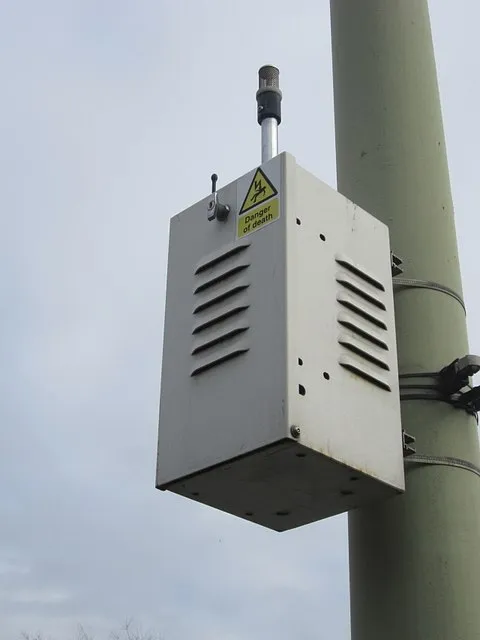
Photo: Richard Webb , CC BY-SA 2.0, via Wikimedia Commons
Air quality policy depends on a simple premise: if a pollutant is measured, it can be regulated. The premise is sound, but the measurement system is not comprehensive. America's regulatory monitoring network is designed for compliance and regional trends, not for the granular, real-time, neighborhood-level data that environmental health research increasingly demands. The gaps are not random. They follow patterns of geography, income, and political priority.
1. Fence-Line Monitoring Remains the Exception
Most industrial facilities are not required to operate continuous fence-line monitors for the pollutants that nearby residents are most likely to breathe. Regulatory monitoring often occurs at a distance, in locations chosen to represent regional air quality rather than the immediate perimeter of a plant. For communities adjacent to refineries, chemical facilities, or waste operations, the difference between a regional monitor and a fence-line monitor can be the difference between a data point and a lived exposure.
Fence-line monitoring is technically feasible. Optical remote sensing, open-path instruments, and stationary sensors can detect leaks and fugitive emissions. But monitoring requirements are often triggered by specific permits or consent agreements, not by a general duty to characterize community exposure. The result is that some of the most exposed residents have the least direct evidence of what is coming over the fence.
2. Wildfire Smoke Exposes the Indoor Air Gap
Outdoor monitors can tell a region that smoke is present, but they cannot tell a household whether the air inside is safe. Wildfire smoke events have made this gap visible. Public health guidance often advises people to stay indoors, yet indoor air quality depends on filtration, building age, ventilation, and whether the occupants can afford portable air cleaners.
Regulatory networks have almost no mandate to measure indoor air in homes, schools, or workplaces. Indoor air is treated as a building management issue rather than a public health exposure. During smoke events, people with asthma, cardiovascular disease, or limited resources may follow official advice and still breathe hazardous air. The data gap becomes a health equity gap.
3. Low-Cost Sensors Are Useful but Not Yet Trustworthy
Low-cost air sensors have expanded access to air quality data, but they are not a substitute for regulatory-grade monitors. Sensor readings can drift, respond differently to humidity and temperature, and confuse different pollutants. Without calibration against reference instruments, a low-cost sensor can produce a confident number that is wrong.
Communities often adopt sensors because they have no other option. That is a legitimate use, but it places the burden of quality control on residents and local groups. A more responsible system would provide calibration infrastructure, standardized reporting, and technical support so that community data can complement rather than confuse the regulatory record.
4. Siting Decisions Follow Old Patterns
Where a monitor is placed determines whose air is measured. Historically, monitoring networks have been sited to support regional compliance and metropolitan trends, not to detect hotspots in low-income neighborhoods or communities of color. A monitor on a downtown rooftop may miss the diesel exhaust corridor beside a warehouse district. A county-level average may conceal a block-level exposure.
The consequences are both scientific and political. Without local data, communities lack the evidence needed to challenge permits, request enforcement, or attract remediation resources. The absence of a monitor becomes a form of invisibility, and invisibility becomes a barrier to protection.
5. Regulatory Averaging Hides the Spikes
Air quality standards often rely on averaging periods that smooth out short-term peaks. That approach can be appropriate for chronic exposure, but it can obscure the acute episodes that trigger asthma attacks, emergency visits, and cardiovascular events. A facility may comply with a daily or annual limit while releasing short bursts of pollution that matter to nearby residents.
Short-term peaks are also difficult to attribute without continuous monitoring. When the data are averaged, the spike disappears into the compliance record. The health cost is borne by people who breathe the peak, not by the entity that reports the average.
Who Pays for the Blind Spots
The costs of missing data are not distributed evenly. They fall on residents who live near industrial activity, on children with asthma, on outdoor workers, and on communities that lack the resources to commission their own monitoring. They also fall on public health agencies that must respond to health complaints without adequate exposure data.
Closing the gaps would require more than additional sensors. It would require a monitoring strategy that explicitly addresses fence-line exposure, indoor air, sensor validation, equitable siting, and short-term peaks. It would require funding for calibration and maintenance, not just equipment. And it would require regulators to treat community-generated data as a signal worth investigating rather than a nuisance to be discounted.
Air quality management cannot protect what it does not measure. The five blind spots are not technical failures alone. They are choices about where to look, and those choices determine whose health is counted.