Protected on the Outside, Exposed Within: The PFAS Blind Spot in America's Firefighter Turnout Gear
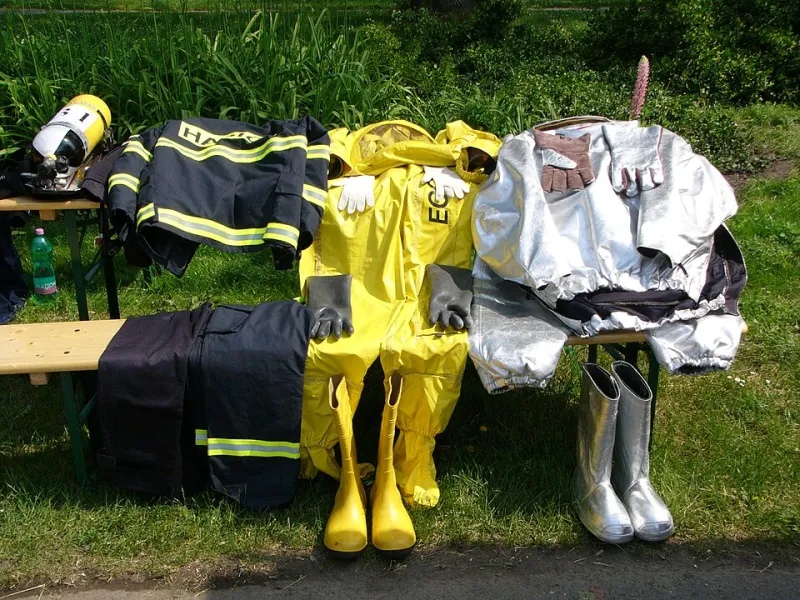
Photo: Michal Maňas, CC BY 2.5, via Wikimedia Commons
Firefighters accept a measure of risk as a condition of duty. Public policy has long recognized that acceptance and has built layers of protection around it, from incident command systems to heat-stress protocols. Turnout gear sits at the center of that bargain. It is treated as the last line of defense, tested and certified to resist flame, heat, water, and abrasion. What the certification system does not routinely ask is whether the materials delivering that protection introduce a different hazard. In the case of per- and polyfluoroalkyl substances, or PFAS, the answer is increasingly difficult to avoid.
PFAS are used in turnout gear for their water- and oil-repellent properties, and they can be present in moisture barriers, outer shells, and thermal liners. The compounds are valued because they perform well under conditions where failure is not an option. They are also persistent, mobile, and associated with health effects that include immune, thyroid, and liver impacts. For firefighters, whose cancer risk is already elevated relative to the general population, the question is not whether chemical exposure matters. It is whether the regulatory system is designed to see it.
A Standard Built for Flame, Not for Chemistry
The National Fire Protection Association's 1971 standard is the reference point for turnout gear. It sets performance requirements for thermal protection, flame resistance, liquid penetration, and durability. Departments and manufacturers rely on it because it translates abstract risk into testable thresholds. But NFPA 1971 is a product-performance standard, not a chemical-safety standard. It does not require disclosure of PFAS content, does not set a maximum for dermal exposure, and does not direct manufacturers to demonstrate that alternative chemistries have been evaluated. Compliance can therefore be complete while chemical risk remains unmeasured.
Procurement reinforces the gap. Fire departments buy gear that meets the standard because meeting the standard is what grants, insurers, and safety officers expect. Underfunded departments have little leverage to demand additional chemical testing, and manufacturers have little incentive to volunteer information that could complicate a sale. The result is a market in which the buyer cannot easily distinguish between a product that passes the required tests and one that reduces a hazard the tests do not address.
The Space Between OSHA and EPA
Occupational safety and health rules require employers to assess workplace hazards and provide protective equipment. They do not, however, treat protective equipment itself as a routine source of chemical exposure. The Environmental Protection Agency regulates chemicals under the Toxic Substances Control Act, but TSCA's article and mixture provisions do not function as a general PFAS-in-textiles prohibition. Drinking-water standards and state foam bans address other pathways. No federal program currently owns the specific problem of PFAS in firefighter turnout gear.
That fragmentation matters because responsibility without ownership produces delay. A fire chief can follow OSHA requirements, purchase NFPA-compliant gear, and still lack a reliable answer about what is in the ensemble. A state can restrict PFAS in firefighting foam without reaching the gear worn on the same call. An EPA reporting rule can capture some chemical production without creating a workplace exposure limit for dermal contact. Each agency can reasonably say that the gap sits elsewhere.
Procurement Without a Signal
Several states have moved to restrict PFAS in firefighting foam, and some are beginning to examine turnout gear. Those efforts are useful, but they do not substitute for a national approach. Fire departments operate across state lines through mutual aid, and gear is often purchased through cooperative contracts. A patchwork of disclosure rules would leave many departments unable to compare products on equal terms.
A credible national strategy would need several components. First, chemical disclosure and labeling should be built into the specification process, so that departments can identify PFAS content before purchase. Second, federal grant programs should reward PFAS-free or reduced-PFAS alternatives without making underfunded departments absorb the premium. Third, a replacement fund should be designed for departments that cannot afford early retirement of contaminated gear. Fourth, exposure monitoring and health surveillance should be funded alongside procurement, because replacing gear without tracking exposure misses the point.
Protecting Firefighters Without Shifting Costs
The policy challenge is not to choose between protection and affordability. It is to design a transition that does not place the cost of reform on the departments least able to pay. A phase-in tied to gear life cycles, combined with procurement preferences and targeted grants, would give manufacturers a predictable market signal. It would also give departments time to plan.
Firefighters already carry enough risk. The gear on their backs should not be an unmeasured part of it. A safety standard that certifies flame resistance but ignores chemical content is not neutral; it directs attention away from a hazard it does not test. The remedy is not to abandon performance standards but to broaden them, and to assign clear responsibility for the exposures they leave out.